
Echoes of Empire
The Coleorton Heritage Group often receives donated items of historical interest. We recently came into possession of an old album containing numerous old post cards and photographs, few of which had any identification. However, on examination it became apparent that this was not the original purpose of the album, since underneath the mixture of 20th Century photographs lay a much older album dating from the 1870’s containing memories of the British Raj. Mostly it was a record of the Murree Theatre Group formed by officers and their wives posted to the hill station at Murree in Rawalpindi, then India, but now in Pakistan, around the 1870s. Where they are visible, beneath later pasted photographs, it seemed to mainly consist of Indian newspaper reviews of these amateur dramatics staged at Government House and the Gaiety Theatre, Simla and photographs of the actors in period costume.
The hill station was also a military outpost and pictures and drawings of military figures were also evident. One remarkable drawing shows a scene drawn during the second Anglo-Afghan war (1878-1880). On the 3rd September 1879 the British envoy to Kabul, Sir Pierre Cavagnari and his entourage were killed by Afghan troops in what appears to have been initially a dispute over pay, but which developed into an outright rebellion. In response a punitive force led by Major General Sir Frederick Roberts was dispatched, comprising Indian and British troops. The British forces crossed in to central Afghanistan and defeated the Afghan Army at the battle of Charasia, on the approaches the Khyber Pass, on 6th October 1879. Two days later the city of Kabul was reoccupied.
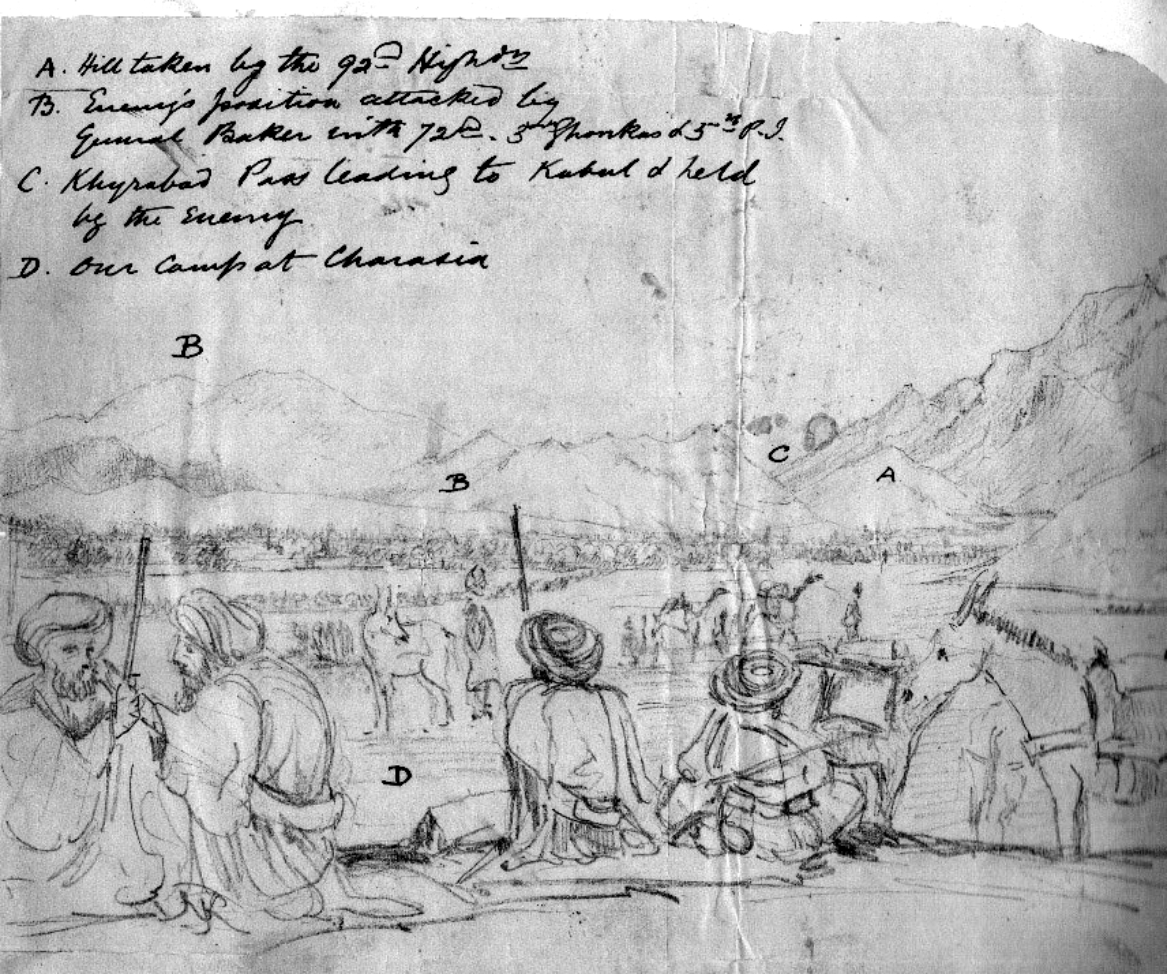
Our album contains a drawing of the British encampment after the battle of Charasia with a caption stating that it was drawn by Capt. Shafto R.A. on 7th October 1879 one week before he was blown up in the explosion at the Bala Hissar. Bala Hissar was a redoubtable Afghan fortress on the outskirts to the city of Kabul. Following the reoccupation, part of the fortress was used by the British as an armoury, but on the 16th October 1879 the gunpowder store exploded killing Capt. Edward Duncombe Shafto and several others. The legend on the drawing states
- A, Hill taken by the 92nd Highlanders;
- B, Enemy’s position attacked by General Baker with 72nd and 3rd Ghurkas and 3rd P.J. (sic);
- C, Khyber Pass leading to Kabul held by the enemy;
- D, Our camp at Charasia. Captain Shafto was buried in the Iranian village of Siah Sang.
Curiously, his bearskin hat is preserved at Durham Cathedral School where he was a former pupil!
The Afghan wars of the 19th Century became known as ‘The Great Game’ a rivalry between the Russian and British Empires for control of the region at the cost much blood and treasure, a lesson from history forgotten by Russia in 1979 and again by Britain in 2001.
Terry Ward
member of the Coleorton Heritage Group
August 2025